A) $51.23.
B) $54.00.
C) $49.11.
D) $61.38.
F) A) and D)
Correct Answer

verified
Correct Answer
verified
A) Capital Gains Rate = 
B) Dividend Yield = 
C) P0 =  +
+ 
D) rE = Capital Gains Rate + Dividend Yield
F) All of the above
Correct Answer
verified
Correct Answer
verified
A) Because capital expenditures can vary substantially from period to period,most practitioners rely on enterprise value to free cash flow multiples.
B) Common multiples to consider are enterprise value to EBIT,EBITDA,and free cash flow.
C) If two stocks have the same payout and EPS growth rates as well as equivalent risk,then they should have the same P/E ratio.
D) Looking at enterprise value as a multiple of sales can be useful if it is reasonable to assume that the firms will maintain similar margins in the future.
F) B) and D)
Correct Answer
verified
Correct Answer
verified
Correct Answer
verified
P1 =  = = $24.10
P0 = + = + = $23.1...View Answer
Correct Answer
verified
= = $24.10P0 =
+ = + = $23.1...View Answer
A) $0.95.
B) $1.40.
C) $1.85.
D) $1.25.
F) A) and D)
Correct Answer
verified
A
Correct Answer
verified
A) 8%.
B) 6%.
C) 4%.
D) 2%.
F) All of the above
Correct Answer
verified
Correct Answer
verified
A) We must discount the cash flows from stock based on the equity cost of capital for the stock.
B) The dividend yield is the percentage return the investor expects to earn from the dividend paid by the stock.
C) The firm might pay out cash to its shareholders in the form of a dividend.
D) The dividend yield is the expected annual dividend of a stock,divided by its expected future sale price.
F) None of the above
Correct Answer
verified
Correct Answer
verified
A) The firm's weighted average cost of capital (WACC) denoted rwacc is the cost of capital that reflects the risk of the overall business,which is the combined risk of the firm's equity and debt.
B) Intuitively,the difference between the discounted free cash flow model and the dividend-discount model is that in the dividend-discount model the firm's cash and debt are included indirectly through the effect of interest income and expenses on earnings in the dividend-discount model.
C) We interpret rwacc as the expected return the firm must pay to investors to compensate them for the risk of holding the firm's debt and equity together.
D) When using the discounted free cash flow model,we should use the firm's equity cost of capital.
F) B) and D)
Correct Answer
verified
D
Correct Answer
verified
A) $2.00.
B) $3.55.
C) $3.87.
D) $4.00.
F) B) and C)
Correct Answer
verified
B
Correct Answer
verified
A) As firms mature,their earnings exceed their investment needs and they begin to pay dividends.
B) Total return equals earnings multiplied by the dividend payout rate.
C) Cutting the firm's dividend to increase investment will raise the stock price if,and only if,the new investments have a positive NPV.
D) We cannot use the constant dividend growth model to value the stock of a firm with rapid or changing growth.
F) All of the above
Correct Answer
verified
Correct Answer
verified
A) $13.00.
B) $22.95.
C) $39.70.
D) $44.35.
F) B) and C)
Correct Answer
verified
Correct Answer
verified
Correct Answer
verified
A manager seeking to boost the price of ...View Answer
Correct Answer
verified
View Answer
A) P0 = 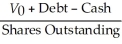
B) V0 =  +
+  + ...+
  +
+ 
C) Free Cash Flow = EBIT × (1 - τc) + Depreciation - Capital Expenditures - ∆NWC
D) Enterprise Value = Market Value of Equity + Debt - Cash
F) B) and C)
Correct Answer
verified
Correct Answer
verified
A) Because the enterprise value represents the entire value of the firm before the firm pays its debt,to form an appropriate multiple,we divide it by a measure of earnings or cash flows after interest payments are made.
B) We can compute a firm's P/E ratio by using either trailing earnings or forward earnings with the resulting ratio called the trailing P/E or forward P/E.
C) It is common practice to use valuation multiples based on the firm's enterprise value.
D) Using a valuation multiple based on comparables is best viewed as a "shortcut" to the discounted cash flow method of valuation.
F) A) and B)
Correct Answer
verified
Correct Answer
verified
A) Future dividend payments and stock prices are not known with certainty;rather these values are based on the investor's expectations at the time the stock is purchased.
B) The capital gain is the difference between the expected sale price and the purchase price of the stock.
C) The sum of the dividend yield and the capital gain rate is called the total return of the stock.
D) We divide the capital gain by the expected future stock price to calculate the capital gain rate.
F) All of the above
Correct Answer
verified
Correct Answer
verified
A) An investor will be willing to pay up to the point at which the current price of a share of stock equals the present value of the expected future dividends and the expected future sale price.
B) The expected total return of a stock should equal the expected return of other investments available in the market with equivalent risk.
C) The total amount received in dividends and from selling the stock will depend on the investor's investment horizon.
D) If the current stock price were greater than P0 =  ,it would be a positive NPV investment,and we would expect investors to rush in and buy it,driving up the stock's price.
F) A) and C)
Correct Answer
verified
Correct Answer
verified
A) 17.00.
B) 13.50.
C) 14.25.
D) 7.00.
F) A) and C)
Correct Answer
verified
Correct Answer
verified
A) 3.5%.
B) 4.0%.
C) 6.0%.
D) 4.5%.
F) C) and D)
Correct Answer
verified
Correct Answer
verified
A) 48%.
B) 50%.
C) 60%.
D) 72%.
F) A) and C)
Correct Answer
verified
Correct Answer
verified
A) $2.00.
B) $16.00.
C) $16.70.
D) $9.90.
F) B) and D)
Correct Answer
verified
Correct Answer
verified
Showing 1 - 20 of 96
Related Exams