Filters
Question type

Study Flashcards

Use the following Table to answer the question : Table 3-35 Use the following Table to answer the question : Table 3-35    -Refer to Table 3-35. Finland's opportunity cost of producing 1 unit of ham is A)  3/2 dozen eggs. This is higher than Denmark's opportunity cost. B)  3/2 dozen eggs. This is lower than Denmark's opportunity cost. C)  2/3 dozen eggs. This is higher than Denmark's opportunity cost. D)  2/3 dozen eggs. This is lower than Denmark's opportunity cost. -Refer to Table 3-35. Finland's opportunity cost of producing 1 unit of ham is


A) 3/2 dozen eggs. This is higher than Denmark's opportunity cost.
B) 3/2 dozen eggs. This is lower than Denmark's opportunity cost.
C) 2/3 dozen eggs. This is higher than Denmark's opportunity cost.
D) 2/3 dozen eggs. This is lower than Denmark's opportunity cost.

E) C) and D)
F) A) and B)

Correct Answer

verifed

verified

Suppose that the country of Xenophobia chose to isolate itself from the rest of the world. Its ruler proclaimed that Xenophobia should become self-sufficient, so it would not engage in foreign trade. From an economic perspective, this idea would


A) make sense if Xenophobia had an absolute advantage in all goods.
B) make sense if Xenophobia had no absolute advantages in any good.
C) not make sense as long as Xenophobia had a comparative advantage in some good.
D) not make sense as long as Xenophobia had an absolute advantage in at least half the goods that could be traded.

E) None of the above
F) All of the above

Correct Answer

verifed

verified

Use the following Figure to answer the question : Figure 3-26 Mary's Production Possibilities Frontier Kate's Production Possibilities Frontier Use the following Figure to answer the question : Figure 3-26 Mary's Production Possibilities Frontier Kate's Production Possibilities Frontier   -Refer to Figure 3-26. What is Kate's opportunity cost of one cookie? -Refer to Figure 3-26. What is Kate's opportunity cost of one cookie?

Correct Answer

verifed

verified

Use the following Figure to answer the question : Figure 3-15 Perry's Production Possibilities Frontier Jordan's Production Possibilities Frontier Use the following Figure to answer the question : Figure 3-15 Perry's Production Possibilities Frontier Jordan's Production Possibilities Frontier    -Refer to Figure 3-15. The opportunity cost of 1 novel for Jordan is A)  1/3 poem. B)  3 poems. C)  4 poems. D)  12 poems. -Refer to Figure 3-15. The opportunity cost of 1 novel for Jordan is


A) 1/3 poem.
B) 3 poems.
C) 4 poems.
D) 12 poems.

E) A) and B)
F) None of the above

Correct Answer

verifed

verified

Use the following Figure to answer the question : Figure 3-26 Mary's Production Possibilities Frontier Kate's Production Possibilities Frontier Use the following Figure to answer the question : Figure 3-26 Mary's Production Possibilities Frontier Kate's Production Possibilities Frontier   -Refer to Figure 3-26. What is Mary's opportunity cost of one muffin? -Refer to Figure 3-26. What is Mary's opportunity cost of one muffin?

Correct Answer

verifed

verified

Use the following Table to answer the question : Table 3-12 Barb and Jim run a business that sets up and tests computers. Assume that Barb and Jim can switch between setting up and testing computers at a constant rate. The following table applies. Use the following Table to answer the question : Table 3-12 Barb and Jim run a business that sets up and tests computers. Assume that Barb and Jim can switch between setting up and testing computers at a constant rate. The following table applies.    -Refer to Table 3-12. The number of minutes needed by Barb to test a computer is A)  36. B)  48. C)  60. D)  64. -Refer to Table 3-12. The number of minutes needed by Barb to test a computer is


A) 36.
B) 48.
C) 60.
D) 64.

E) A) and B)
F) A) and C)

Correct Answer

verifed

verified

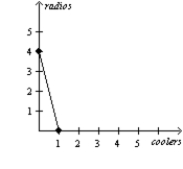
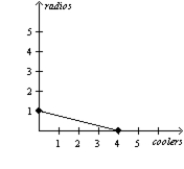
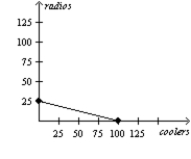
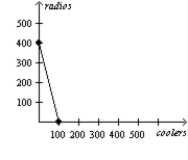
Use the following Table to answer the question : Table 3-5 Assume that Aruba and Iceland can switch between producing coolers and producing radios at a constant rate. Use the following Table to answer the question : Table 3-5 Assume that Aruba and Iceland can switch between producing coolers and producing radios at a constant rate.    -Refer to Table 3-5. Which of the following represents Iceland's production possibilities frontier when 100 labor hours are available? A)    B)    C)    D)   -Refer to Table 3-5. Which of the following represents Iceland's production possibilities frontier when 100 labor hours are available?


A)
Use the following Table to answer the question : Table 3-5 Assume that Aruba and Iceland can switch between producing coolers and producing radios at a constant rate.    -Refer to Table 3-5. Which of the following represents Iceland's production possibilities frontier when 100 labor hours are available? A)    B)    C)    D)
B)
Use the following Table to answer the question : Table 3-5 Assume that Aruba and Iceland can switch between producing coolers and producing radios at a constant rate.    -Refer to Table 3-5. Which of the following represents Iceland's production possibilities frontier when 100 labor hours are available? A)    B)    C)    D)
C)
Use the following Table to answer the question : Table 3-5 Assume that Aruba and Iceland can switch between producing coolers and producing radios at a constant rate.    -Refer to Table 3-5. Which of the following represents Iceland's production possibilities frontier when 100 labor hours are available? A)    B)    C)    D)
D)
Use the following Table to answer the question : Table 3-5 Assume that Aruba and Iceland can switch between producing coolers and producing radios at a constant rate.    -Refer to Table 3-5. Which of the following represents Iceland's production possibilities frontier when 100 labor hours are available? A)    B)    C)    D)

E) A) and D)
F) B) and C)

Correct Answer

verifed

verified

Use the following scenario to answer the question : Scenario 3-2 In country A a worker who works 40 hours can produce 200 pounds of rice or 100 pounds of broccoli. In country B a worker who works 40 hours can produce 160 pounds of rice or 120 pounds of broccoli. -Refer to Scenario 3-2. Give a range of prices in terms of pounds of rice per pound of broccoli at which the two countries would be both be willing to trade.

Correct Answer

verifed

verified

Any price which is less than 2...

View Answer

Use the following Table to answer the question : Table 3-9 Assume that Maya and Miguel can switch between producing mixers and producing toasters at a constant rate. Use the following Table to answer the question : Table 3-9 Assume that Maya and Miguel can switch between producing mixers and producing toasters at a constant rate.    -Refer to Table 3-9. We could use the information in the table to draw a production possibilities frontier for Maya and a second production possibilities frontier for Miguel. If we were to do this, measuring mixers along the horizontal axis, then A)  the slope of Maya's production possibilities frontier would be ­2 and the slope of Miguel's production possibilities frontier would be -2. B)  the slope of Maya's production possibilities frontier would be ­0.5 and the slope of Miguel's production possibilities frontier would be -0.5. C)  the slope of Maya's production possibilities frontier would be ­1.67 and the slope of Miguel's production possibilities frontier would be -1.67. D)  the slope of Maya's production possibilities frontier would be ­0.6 and the slope of Miguel's production possibilities frontier would be -0.6. -Refer to Table 3-9. We could use the information in the table to draw a production possibilities frontier for Maya and a second production possibilities frontier for Miguel. If we were to do this, measuring mixers along the horizontal axis, then


A) the slope of Maya's production possibilities frontier would be ­2 and the slope of Miguel's production possibilities frontier would be -2.
B) the slope of Maya's production possibilities frontier would be ­0.5 and the slope of Miguel's production possibilities frontier would be -0.5.
C) the slope of Maya's production possibilities frontier would be ­1.67 and the slope of Miguel's production possibilities frontier would be -1.67.
D) the slope of Maya's production possibilities frontier would be ­0.6 and the slope of Miguel's production possibilities frontier would be -0.6.

E) None of the above
F) A) and B)

Correct Answer

verifed

verified

Use the following Figure to answer the question : Figure 3-20 Canada's Production Possibilities Frontier Mexico's Production Possibilities Frontier Use the following Figure to answer the question : Figure 3-20 Canada's Production Possibilities Frontier Mexico's Production Possibilities Frontier   -Refer to Figure 3-20. Mexico would incur an opportunity cost of 8 units of Good X if it increased its production of Good Y by A)  2 units. B)  4 units. C)  6 units. D)  8 units. -Refer to Figure 3-20. Mexico would incur an opportunity cost of 8 units of Good X if it increased its production of Good Y by


A) 2 units.
B) 4 units.
C) 6 units.
D) 8 units.

E) C) and D)
F) B) and D)

Correct Answer

verifed

verified

The gains from specialization and trade are based on advantage.

Correct Answer

verifed

verified

Use the following Figure to answer the question : Figure 3-3 Arturo's Production Possibilities Frontier Dina's Production Possibilities Frontier Use the following Figure to answer the question : Figure 3-3 Arturo's Production Possibilities Frontier Dina's Production Possibilities Frontier    -Refer to Figure 3-3. If the production possibilities frontiers shown are each for one day of production, then which of the following combinations of tacos and burritos could Arturo and Dina together not produce in a given day? A)  200 tacos and 400 burritos B)  300 tacos and 350 burritos C)  400 tacos and 300 burritos D)  600 tacos and 250 burritos -Refer to Figure 3-3. If the production possibilities frontiers shown are each for one day of production, then which of the following combinations of tacos and burritos could Arturo and Dina together not produce in a given day?


A) 200 tacos and 400 burritos
B) 300 tacos and 350 burritos
C) 400 tacos and 300 burritos
D) 600 tacos and 250 burritos

E) A) and C)
F) A) and B)

Correct Answer

verifed

verified

Goods produced abroad and sold domestically are called


A) exports.
B) imports.
C) exchange rates.
D) opportunity costs.

E) C) and D)
F) B) and C)

Correct Answer

verifed

verified

Use the following Figure to answer the question : Figure 3-3 Arturo's Production Possibilities Frontier Dina's Production Possibilities Frontier Use the following Figure to answer the question : Figure 3-3 Arturo's Production Possibilities Frontier Dina's Production Possibilities Frontier    -Refer to Figure 3-3. If the production possibilities frontier shown for Arturo is for 100 hours of production, then how long does it take Arturo to make one burrito? A)  1/4 hour B)  1/3 hour C)  3 hours D)  4 hours -Refer to Figure 3-3. If the production possibilities frontier shown for Arturo is for 100 hours of production, then how long does it take Arturo to make one burrito?


A) 1/4 hour
B) 1/3 hour
C) 3 hours
D) 4 hours

E) A) and D)
F) A) and C)

Correct Answer

verifed

verified

Use the following Table to answer the question : Table 3-1 :  Use the following Table to answer the question : Table 3-1 :  Assume that John and Jane can switch between producing bread and wine at a constant rate. Assume that John and Jane each work 24 hours. What happens to total production if instead of each person spending 12 hours producing each good, Jane spends 21 hours producing wine and 3 hours producing bread and John spends 3 hours producing wine and 21 hours producing bread? A)  The total production of bread and wine each rise. B)  The total production of bread rises and the total production of wine falls. C)  The total production of bread falls and the total production of wine rises. D)  The total production of bread and wine each fall.Assume that John and Jane can switch between producing bread and wine at a constant rate. Assume that John and Jane each work 24 hours. What happens to total production if instead of each person spending 12 hours producing each good, Jane spends 21 hours producing wine and 3 hours producing bread and John spends 3 hours producing wine and 21 hours producing bread?


A) The total production of bread and wine each rise.
B) The total production of bread rises and the total production of wine falls.
C) The total production of bread falls and the total production of wine rises.
D) The total production of bread and wine each fall.

E) B) and D)
F) All of the above

Correct Answer

verifed

verified

Henry can make a bird house in 3 hours and he can make a bird feeder in 1 hour. The opportunity cost to Henry of making a bird house is 1/3 bird feeder.

A) True
B) False

Correct Answer

verifed

verified

Use the following Table to answer the question : Table 3-5 Assume that Aruba and Iceland can switch between producing coolers and producing radios at a constant rate. Use the following Table to answer the question : Table 3-5 Assume that Aruba and Iceland can switch between producing coolers and producing radios at a constant rate.    -Refer to Table 3-5. Assume that Aruba and Iceland each has 80 labor hours available. If each country divides its time equally between the production of coolers and radios, then total production is A)  28 coolers and 50 radios. B)  30 coolers and 9 radios. C)  60 coolers and 18 radios. D)  120 coolers and 36 radios. -Refer to Table 3-5. Assume that Aruba and Iceland each has 80 labor hours available. If each country divides its time equally between the production of coolers and radios, then total production is


A) 28 coolers and 50 radios.
B) 30 coolers and 9 radios.
C) 60 coolers and 18 radios.
D) 120 coolers and 36 radios.

E) None of the above
F) All of the above

Correct Answer

verifed

verified

Use the following Table to answer the question : Table 3-22 Assume that Zimbabwe and Portugal can switch between producing toothbrushes and producing hairbrushes at a constant rate. Use the following Table to answer the question : Table 3-22 Assume that Zimbabwe and Portugal can switch between producing toothbrushes and producing hairbrushes at a constant rate.    -Refer to Table 3-22. Assume that Zimbabwe and Portugal each has 60 machine minutes available. Originally, each country divided its time equally between the production of toothbrushes and hairbrushes. Now, each country spends all its time producing the good in which it has a comparative advantage. As a result, the total output increased by A)  4 toothbrushes and 2 hairbrushes. B)  10 toothbrushes and 5 hairbrushes. C)  16 toothbrushes and 8 hairbrushes. D)  20 toothbrushes and 10 hairbrushes. -Refer to Table 3-22. Assume that Zimbabwe and Portugal each has 60 machine minutes available. Originally, each country divided its time equally between the production of toothbrushes and hairbrushes. Now, each country spends all its time producing the good in which it has a comparative advantage. As a result, the total output increased by


A) 4 toothbrushes and 2 hairbrushes.
B) 10 toothbrushes and 5 hairbrushes.
C) 16 toothbrushes and 8 hairbrushes.
D) 20 toothbrushes and 10 hairbrushes.

E) B) and D)
F) B) and C)

Correct Answer

verifed

verified

Use the following Figure to answer the question : Figure 3-16 Hosne's Production Possibilities Frontier Merve's Production Possibilities Frontier Use the following Figure to answer the question : Figure 3-16 Hosne's Production Possibilities Frontier Merve's Production Possibilities Frontier   -Refer to Figure 3-16. Merve should specialize in the production of A)  purses. B)  wallets. C)  both goods. D)  neither good. -Refer to Figure 3-16. Merve should specialize in the production of


A) purses.
B) wallets.
C) both goods.
D) neither good.

E) A) and D)
F) C) and D)

Correct Answer

verifed

verified

Use the following Figure to answer the question : Figure 3-2 Brazil's Production Possibilities Frontier Use the following Figure to answer the question : Figure 3-2 Brazil's Production Possibilities Frontier   -Refer to Figure 3-2. If the production possibilities frontier shown is for 24 hours of production, then how long does it take Brazil to make one peanut? A)  1/10 hour B)  1/3 hour C)  3 hours D)  10 hours -Refer to Figure 3-2. If the production possibilities frontier shown is for 24 hours of production, then how long does it take Brazil to make one peanut?


A) 1/10 hour
B) 1/3 hour
C) 3 hours
D) 10 hours

E) All of the above
F) A) and B)

Correct Answer

verifed

verified

Showing 81 - 100 of 527

Related Exams

Show Answer